Did a Student Really Use AI? A Fair Guide for Teachers
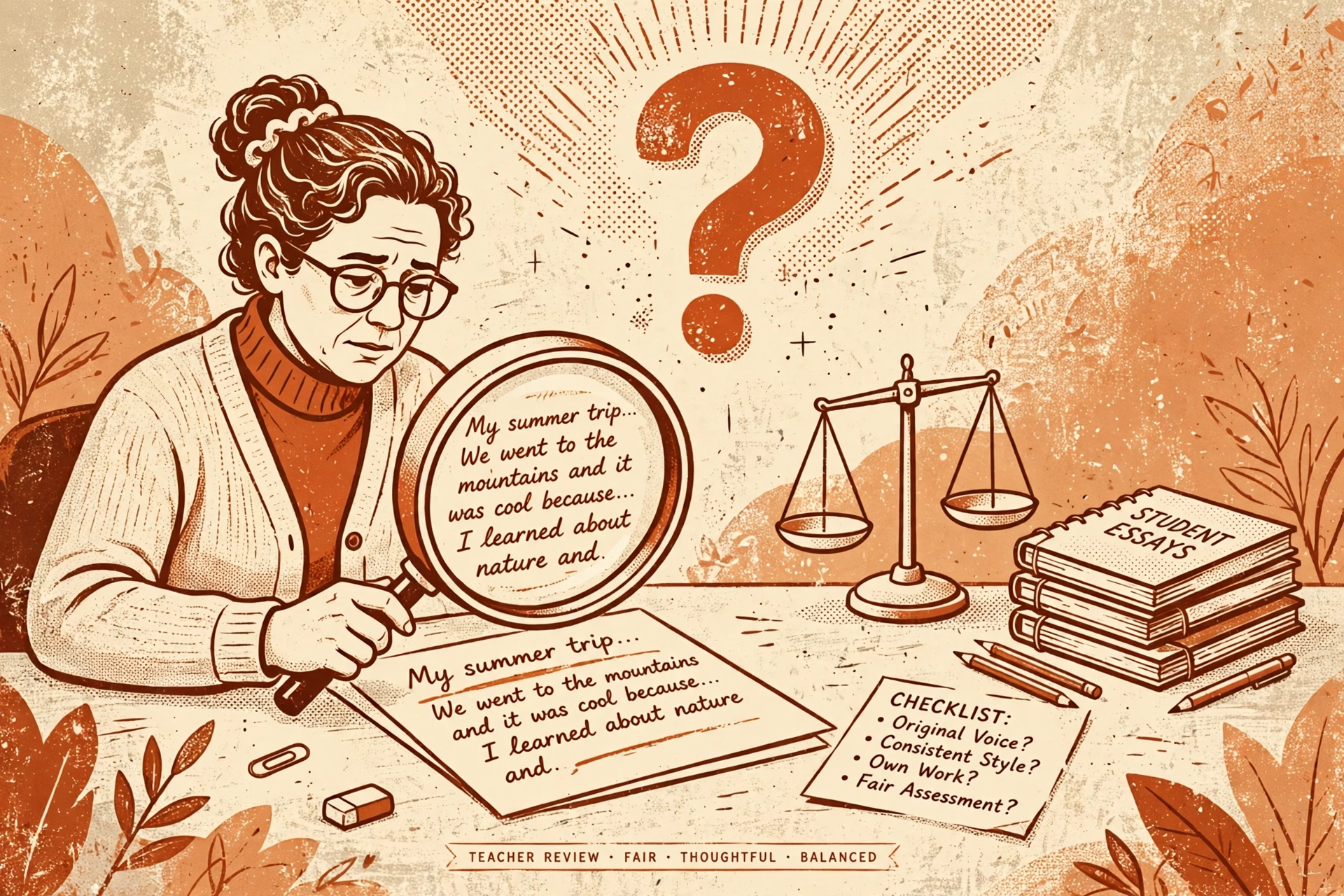
A detector score is a suspicion, not a verdict. Fairness starts with what you do next.
The essay is suspiciously good. The sentences are smooth, the vocabulary is grown-up, and a free detector website says “87% AI-generated”. It is tempting to treat that number as proof. Please don't. Detectors are much weaker than they look, and a false accusation is not a small error — it tells an honest student that their real work counts for nothing. Here is what the evidence says, and a fairer way to handle the suspicion.
Why detectors misfire
Detectors do not actually detect AI. They measure how predictable a text is — how often each next word is the obvious choice. Formal, careful writing scores as “AI-like”. And careful, simple, predictable writing is exactly how students produce English when it is their second language: safe sentences, common words, phrases from the textbook.
In a widely reported Stanford study, popular detectors flagged more than half of TOEFL essays written by non-native English speakers as AI-generated, while almost never flagging essays by native speakers. Several universities have since advised against using detector scores in decisions about students. The tools are not lying — they are simply answering a different question from the one teachers ask.
What a high score really means
Treat it as a smoke alarm, not a fire report. A smoke alarm means “go and look” — and usually it is toast. A detector score means “look closer, kindly”. The score cannot see drafts, effort, dictionaries, an elder sibling's help, or three evenings of work. You can see all of that — if you look.
Four fair checks that actually work
- Compare with class writing. You already own the best evidence: the student's supervised work. A sudden jump of two levels deserves a conversation. Steady quality deserves none.
- Ask for the story of the work. Two minutes is enough: “Which part was hardest? Why did you pick this example?” A student who wrote something can talk about it. A student who pasted it usually cannot — and even then, you have learned it by listening, not by accusing.
- Look for a process. Notes, a rough draft, version history in a document. Ask every student for these as a routine from the start of term, so it is never a trap set for one child.
- Settle it gently in class. A short paragraph on the same topic, written in front of you, answers most doubts — kindly, quickly, and finally.
Have the conversation privately — and curiously
Never accuse a student in front of the class. Ask, don't declare: “This reads differently from your class work — walk me through how you wrote it.” If the student did cross the line, you have enforced a standard without breaking trust, and you can set the consequence calmly. If they didn't, you have protected the exact student every teacher dreams of: one who worked hard and wrote well.
Set the rules before the work, not after
Most “AI cheating” in schools is really unclear rules. Say plainly, at the start, what help is allowed in your class: ideas and outlines? A grammar check? Nothing at all? Write it on the board and keep it there. Our guide for students makes the same distinction from their side: learning with AI is guidance; submitting AI's words as your own is cheating. When the line is public, most students respect it.
Your judgment, one honest conversation, and the student's own class work will always beat a percentage on a website.
Detectors will improve, and AI will improve with them; the contest never ends. The fair process above does not expire. When you are unsure, choose the response that keeps an honest student honest — that is the whole job.
Keep reading
How-To Guides
How Students Can Use AI to Study Smarter (Without Cheating)
AI can be a brilliant study partner. Here’s how to use it for real learning — and where to draw the line.
How-To Guides
8 Ways Teachers Are Saving Hours With AI This Year
Lesson drafts, quizzes, parent messages, and more — eight practical ways teachers are getting their evenings back with AI.
How-To Guides
5 AI Tools That Save Teachers 5 Hours a Week — With Real Classroom Examples
Lesson plans in 10 minutes, worksheets at three levels, and parent messages that write themselves. A practical workflow for busy teachers.