How to Learn English Faster With AI: A Teacher's Guide
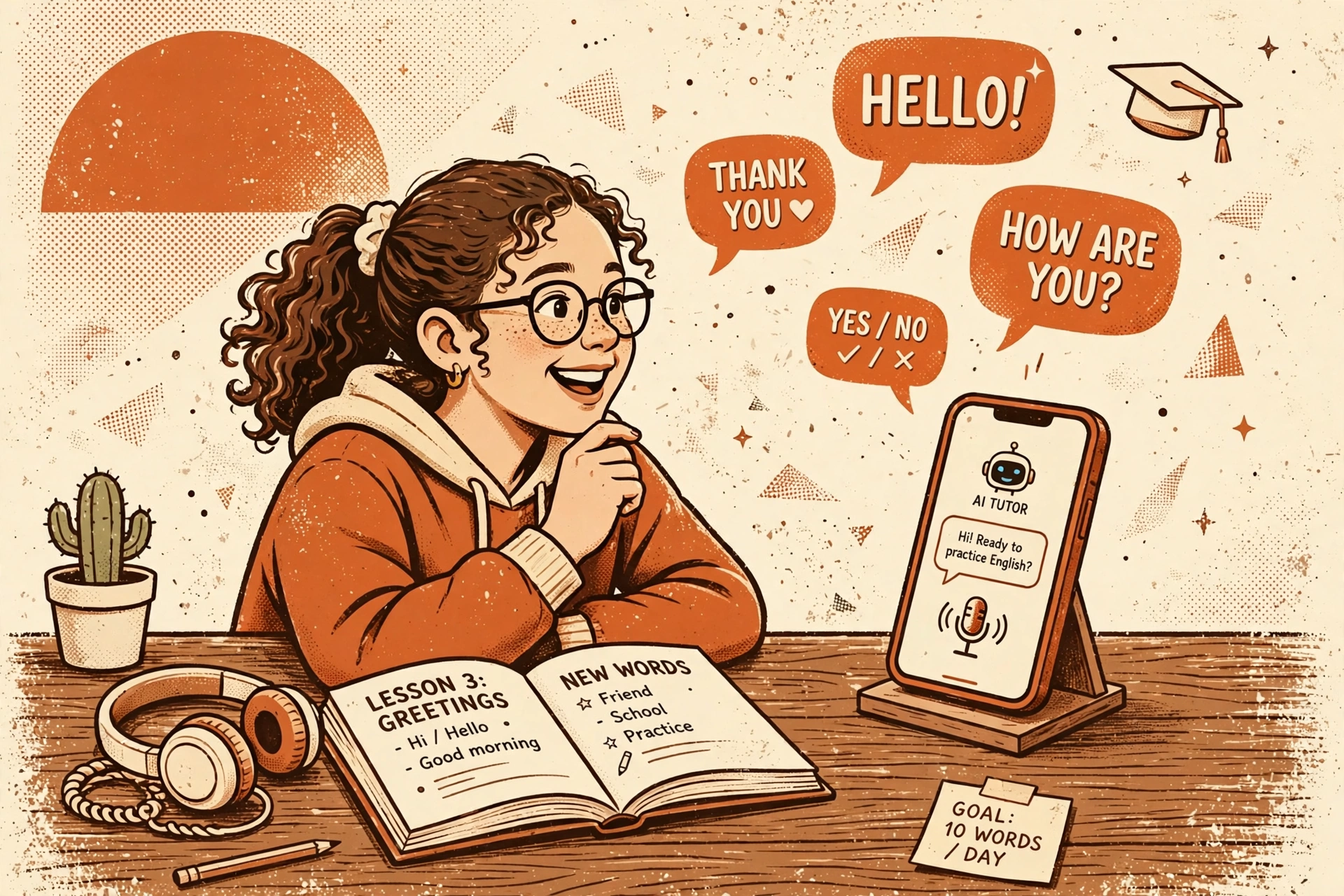
The patient speaking partner every English learner wishes for — now in your pocket.
Every English learner knows the real problem: there is nobody to practise with. You can study grammar for years and still freeze when someone simply asks, “How are you?” AI removes that problem completely. A chatbot never gets tired, never laughs at a mistake, and is awake at six in the morning before school. I teach English for a living — here is how I would use it.
1. Talk out loud every day
Speaking is a muscle. Ten quiet minutes of reading will never do what ten minutes of actual conversation does. The voice mode in ChatGPT, Claude, or Gemini turns your phone into a patient partner. Start with a script like this:
You are a friendly English tutor. Talk with me for 10 minutes about my day. Speak slowly, use simple words, ask me one question at a time, and gently correct my mistakes after each of my answers.
Shy at first? Everyone is. That is the point of practising with a machine: the embarrassment is free, and it disappears within a week.
2. Get your writing corrected the same day
Write five to eight sentences yourself first — about your village, your family, your job, yesterday. Your own sentences, however rough. Then ask:
Correct my English. For each mistake, show me the wrong sentence, the correct sentence, and one simple rule I can remember.
Keep a small “my mistakes” notebook — a real notebook or a notes app. Review it every Friday. That short list of your own repeated errors is the most personal syllabus you will ever own.
3. Learn words inside sentences, not from lists
A list gives you a meaning on Monday and takes it back by Friday. Words stick when they arrive inside a picture. Instead of memorising twenty words, learn five like this:
Teach me the word 'borrow'. Give me five short sentences from daily life — school, home, the market. Then ask me to make my own sentence with it.
Five words a day, learned properly, is about 150 words a month — each one attached to a scene you can actually recall. This is also what I tell my own students: sentences first, lists last.
4. Listen, read, repeat
Ask the AI to write a six-line dialogue at your level, set somewhere real: at the doctor, buying bus tickets, a parent–teacher meeting. Listen to it read aloud, read along silently, then repeat each line out loud, copying the music of it. Teachers call this shadowing. It feels strange for two days — and then your mouth starts knowing English before your brain does.
5. A 20-minute routine that fits a real life
- 5 minutes speaking — voice chat about yesterday: what you did, in the past tense.
- 5 minutes writing — five sentences, corrected, mistakes into the notebook.
- 5 words — learned inside sentences, with one sentence of your own for each.
- 5 minutes shadowing — one short dialogue, repeated until it feels easy.
Attach it to something you already do — after morning prayers, on the bus, after dinner. Miss a day? Restart the next. Restarting is the habit; streaks are decoration.
Three rules, so AI builds your English instead of replacing it
- Your words first. Always make your own attempt before asking. The struggle is not a delay in learning — it is the learning.
- Check strange explanations. AI occasionally invents grammar “rules” with total confidence. If something feels odd, verify it with a teacher or a trusted grammar site.
- Never hand in AI's English as yours. In exams and assessed work that is cheating — and it steals the very practice that would have made you fluent. Our student guide draws the same line.
AI will not learn English for you. But it has quietly removed the oldest excuse — “I have nobody to practise with” — forever.
Start tonight: open the voice chat, use the speaking script above, and talk about your day for ten minutes. Then do it again tomorrow. If you want the prompting habits behind all of this, our prompt techniques guide is the natural next read.
Keep reading
How-To Guides
How Students Can Use AI to Study Smarter (Without Cheating)
AI can be a brilliant study partner. Here’s how to use it for real learning — and where to draw the line.
How-To Guides
How to Write Better Prompts: 10 Techniques That Actually Work
Better prompts aren’t magic words — they’re habits. Ten practical techniques that level up any AI chatbot, with examples.
How-To Guides
8 Ways Teachers Are Saving Hours With AI This Year
Lesson drafts, quizzes, parent messages, and more — eight practical ways teachers are getting their evenings back with AI.